
If you’re building a new home, carrying out a renovation or planning a self-build project, you’ve probably come across the term air tightness testing.
But what exactly is an air tightness test, why is it important and what does it tell you about your building?
This guide explains the purpose of air tightness testing, how it works and why it has become an important part of modern, energy-efficient construction.
What is Air Tightness Testing?
Air tightness testing, sometimes referred to as an air permeability test, measures how much uncontrolled air leaks through the external envelope of a building.
A well-sealed building is generally more energy efficient because less warm air escapes through unwanted gaps and draughts. Reducing uncontrolled air leakage helps improve comfort, lower heating demand and improve the overall performance of a building.
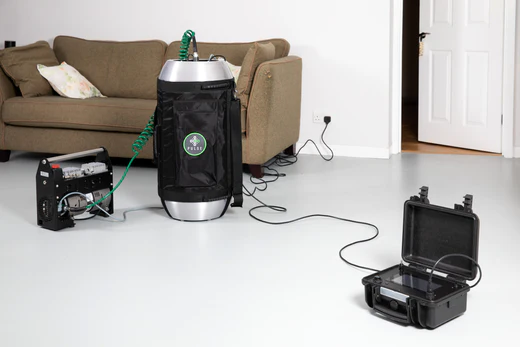
At TargetCO2, we use the approved Pulse air testing method to measure air permeability quickly and accurately.
Why Is Air Tightness Important?
No building is completely airtight.
However, excessive uncontrolled air leakage can lead to:
- Higher heating bills
- Reduced energy efficiency
- Draughts and cold spots
- Reduced occupant comfort
- Less effective insulation performance
Good air tightness isn’t about eliminating ventilation. Modern buildings should be both well sealed and properly ventilated, ensuring fresh air is introduced in a controlled way rather than through unwanted gaps in the building fabric.
How Does Air Tightness Testing Work?
Before testing, the building is prepared in accordance with the relevant testing standard.
Using specialist Pulse equipment, a controlled pulse of air is briefly introduced into the building. Sensitive instruments then measure how the building responds, allowing the equipment to accurately calculate the property’s air permeability.
The process is quick, non-invasive and provides an accurate measurement of the building’s airtightness performance.
Once complete, the results are analysed and a certificate can be issued where required.
Air Tightness and Retrofit Projects
For existing buildings undergoing retrofit work, improving air tightness is one of the key measures to boost energy efficiency. By sealing gaps and cracks, older homes can benefit from enhanced insulation and reduced heat loss. In retrofit projects, air tightness testing is particularly vital for Path C projects under the ECO4 scheme. Ensuring compliance with industry frameworks like TrustMark and IAA ensures that retrofitted properties meet the highest standards.
What Can Affect an Air Tightness Test?
Several factors influence a building’s air tightness, including:
- Gaps around service penetrations
- Poorly sealed windows and doors
- Loft hatches
- Pipe and cable entries
- Junctions between different building elements
- General quality of workmanship
- Attention to detail during construction often has the greatest influence on the final result.
Why Does Air Tightness Matter?
A building with good air tightness can provide several benefits:
- Improved energy efficiency
- Lower heating costs
- Greater thermal comfort
- Reduced unwanted draughts
- Better overall building performance
For new-build projects, air tightness also forms an important part of demonstrating the building performs as designed.
Can Air Leakage Be Improved?
Yes.
If excessive air leakage is identified, improvements are often straightforward.
Common areas to address include:
- Sealing service penetrations
- Improving window and door sealing
- Closing gaps around structural junctions
- Improving workmanship around the building envelope
Identifying these areas early can help avoid more extensive remedial work later in the project.
Air Tightness Testing Across the South West
TargetCO2 provides professional air tightness testing for:
- New-build homes
- Self-build projects
- Commercial buildings
- Residential developments
We work with homeowners, builders, developers, architects and retrofit professionals across Devon, Cornwall, Somerset, Dorset, Bristol and Bath, providing prompt testing, practical advice and certification where required.
If you’d like to learn when an air tightness test is required for Building Regulations or Building Control, read our guide: When Is an Air Tightness Test Required?
Or, if you’re ready to arrange testing, contact TargetCO2 today for friendly advice and a competitive quotation.